
Meta and Google advertising
Meta Ads or Google Ads: how to choose for your business
The question is not which platform is best overall, but where you can reach your customer, with what message and at which decision stage. Here we compare Google Search campaigns with discovery advertising on Meta; both ecosystems also offer other formats.
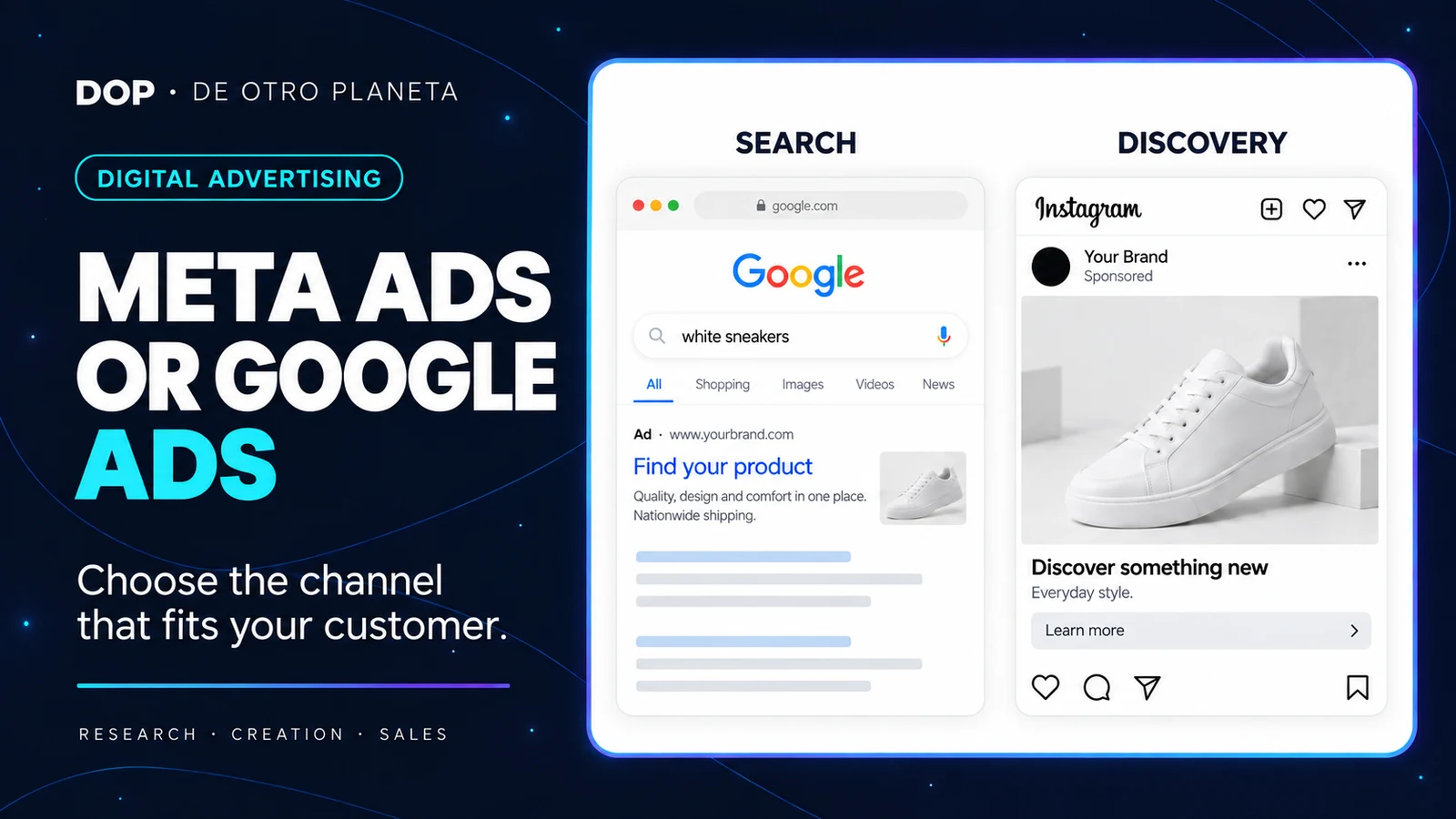
Meta Ads and Google Search: differences at a glance
This table summarizes the search and discovery approaches discussed here. It does not compare every Google and Meta format or guarantee costs or results. On mobile, scroll the table sideways.
| Criterion | Google Search | Meta: Facebook and Instagram |
|---|---|---|
| Buyer’s moment | Already searching for a category, provider or solution. | Discovering an offer while browsing content. |
| Starting point | Identifiable demand and relevant searches. | A recognizable problem and a clear visual demonstration. |
| Message and destination | An offer and landing page answering the specific query. | Creative explaining the solution and continuing on a page or in a conversation. |
| What to review | Search terms, commercial intent and inquiry quality. | Message clarity, creative assets and opportunity quality. |
| Risk to avoid | Paying for clicks from searches that do not fit. | Confusing engagement with business opportunities. |
Google Search: responding to an existing need
Search network ads can appear for queries related to your keywords. This lets you present an offer to people already searching for a category, provider or solution.
Consider this channel when identifiable demand exists. The landing page should answer the search with a specific offer, clear terms and an easy action. Paying for clicks does not guarantee suitable inquiries.
- Example: a business searches for a supplier of a specific technology.
- Review search terms and queries that do not match your service.
- Distinguish informational searches from searches with commercial intent.
Meta: introducing a solution before people search for it
Facebook and Instagram advertising can introduce an offer while people discover content. A visual demonstration or customer story can explain something they are not yet searching for by name.
This approach requires a clear message and relevant creative assets. An eye-catching ad without a clear offer can generate engagement without business opportunities.
- Example: a video showing how to use a product that needs demonstration.
- Explain the problem, solution and next step without exaggerated promises.
- Connect the ad to a page or conversation that continues the same story.
Choose based on your sales process
At De Otro Planeta, we use these questions as a decision framework, not an automatic rule. Industry, location, pricing and service capacity affect each channel's suitability.
- Demand: is your customer already searching for this solution, or must you explain it first?
- Demonstration: do buyers need to see the product in use to understand its value?
- Sales: can they buy online, or do they need an advisor and a quote?
- Operations: can you respond to opportunities and follow up?
- Measurement: can you connect inquiries, quotes and sales to campaigns?
What to check before choosing or combining channels
These are De Otro Planeta’s working criteria, not automatic recommendations. Verify your situation before allocating a budget.
| Situation | Approach to evaluate | Necessary check |
|---|---|---|
| Customers already search for the solution | Evaluate Google Search. | Relevant demand and terms; a page answering the search. |
| Buyers need to see the product to understand it | Evaluate discovery on Meta. | Visual assets, a clear offer and a coherent next step. |
| People discover the brand, then search for it | Evaluate combining both. | Consistent attribution without duplicate conversions. |
| Inquiries arrive but do not progress | Review customer service before increasing spending. | Ownership, follow-up, quotes and confirmed sales. |
When to combine them and what to measure
Both channels can contribute to one journey: someone discovers a brand in an ad, then searches for it. That does not mean every business should invest in both from the start.
Start with a business hypothesis and a budget you can evaluate. Compare opportunity cost and quality, not only reach, clicks or messages. Check attribution and duplicate conversions before adding results across platforms.
The landing page, WhatsApp and sales team are part of the campaign. No platform can fix an unclear offer or customer service that fails to support the buyer on its own.
Sources and references
STRATEGY · CREATION · SALES
Let's turn the idea into a plan for your business.
Let's review your offer, your customer journey and improvements that make sense for your business.
Explore our business advertising strategy ↗Let's discuss your project ↗