
Digital experiences
Virtual reality, augmented reality or a 3D configurator: what does your business need?
Not every digital experience needs a headset. The choice depends on what customers need to understand: exploring a product, seeing it in their space or experiencing a situation. Technology should serve that task.
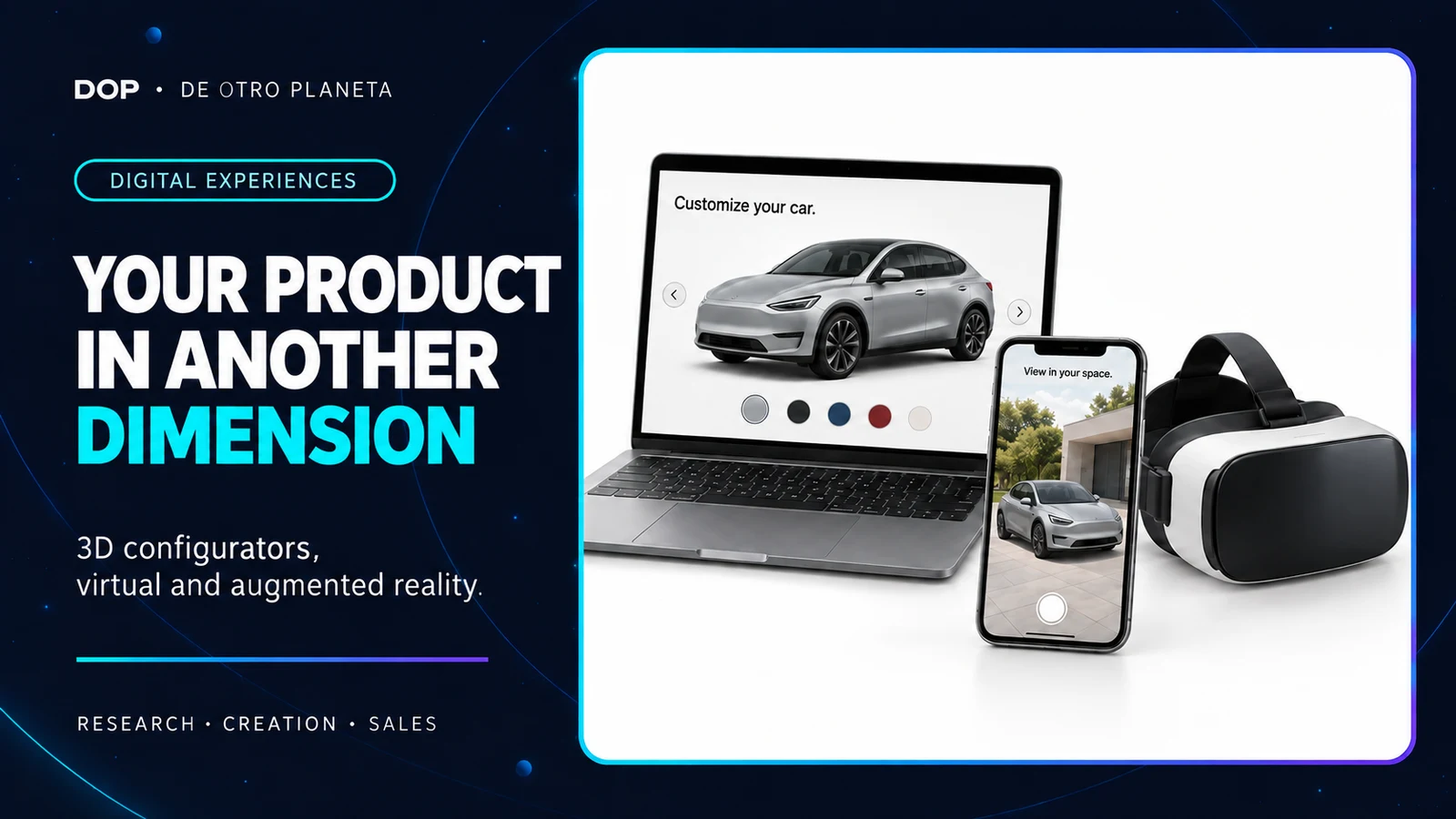
3D configurators: explore and customize on the web
A configurator lets people inspect a model from different angles and, depending on its implementation, change materials, colors or components. It can work on a computer or phone without a VR headset.
In an automotive experience, for example, buyers can explore the exterior and interior and compare options before visiting a dealership. Combinations should match the real catalog; a visualization does not replace a quote or physical test drive.
- Useful for products with variations or details that are hard to explain in a photo.
- Prioritize fast loading, simple controls and clear access to an advisor.
- Check that colors, scale and components do not create misleading expectations.
Augmented reality: a product in the real environment
Augmented reality overlays digital content on the surroundings a person sees. Depending on the device and implementation, it can help visualize an object in a living room, trade show or workplace.
This differs from replacing the entire environment with a virtual scene. Before offering life-size visualization, validate scale, spatial tracking and device limitations. Phones, browsers and headsets do not all support the same features.
Virtual reality: stepping inside an experience
With a compatible headset, virtual reality presents an immersive environment. It can support tours, demonstrations or simulations of situations that would be difficult to bring physically to a meeting.
Define what someone should experience and how long it takes. A brief commercial demo should have a clear purpose and consider comfort, accessibility, available space and assistance during use.
Start with the decision you want to make easier
A configurator may be enough to compare finishes. To place a product in a customer's space, consider augmented reality. To explore an environment or immersive viewpoint, consider virtual reality.
These options can be combined, but each feature adds production and testing needs. Agreeing on a verifiable scope is more useful than assembling technologies without an objective.
- Define the product, audience, devices and setting.
- Prepare models, materials and permissions for visual assets.
- Provide a conventional alternative for unsupported devices.
- Measure relevant actions: variants explored, demonstrations and contact requests.
From an example to an experience for your brand
Our business experiences page features DOP Car Experience, De Otro Planeta Vision Web XR and Aura Live. These examples help discuss possibilities and define your project's needs.
WebXR compatibility depends on the browser and device. Web browsing and immersive mode are not equivalent on every device; both journeys require testing before launch.
Sources and references
STRATEGY · CREATION · SALES
Let's turn the idea into a plan for your business.
Let's review your offer, your customer journey and improvements that make sense for your business.
Explore DOP Car Experience, Vision Web XR and Aura Live ↗Let's discuss your project ↗