
Strategy and sales
How to sell on WhatsApp in five steps: the method I use to guide a conversation
When someone messages me on WhatsApp, my job is to help them choose and move forward. I break the conversation into five steps: understand what they need, explain the benefits, show three options, suggest one action, and work out payment and delivery.
Watch the five steps in action
Watch on YouTube (Spanish audio) ↗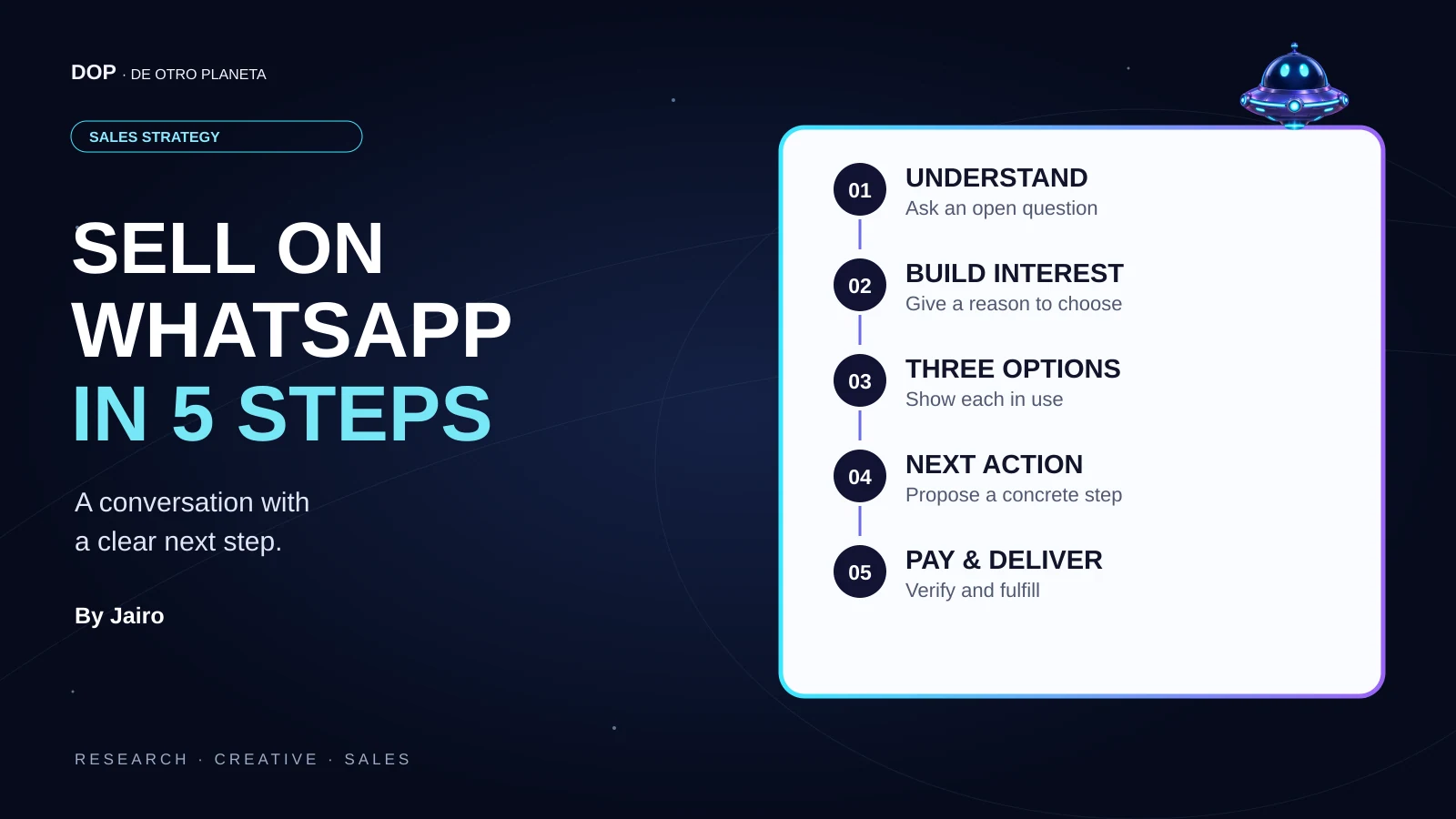
Before I offer anything, I find out what the person needs
My team works with people from their first inquiry until they are ready for an appointment, a call, or a purchase. We use people and AI, staff training, and follow-up. A tool earns its place when it helps the next person pick up a conversation with the right context.
Picture a clothing store. A customer asks about a shirt and gets a stream of catalog photos. The salesperson has shown plenty, but still doesn’t know what occasion the customer has in mind, what they like, or what they need. The same thing happens in a service business when we answer “We do everything. What do you need?” and leave the customer to work out the rest.
I like to give a conversation direction. If someone has already explained what they want, I build on that. If they ask the price, I give them the price and the terms that apply. Neither of us benefits from working through a script before they get an answer.
The conversations and businesses below are hypothetical examples of the method.
1. Ask an open question to understand the need
I start with a question that gives the customer room to explain. “What are you looking for, and what will you use it for?” opens up a different conversation from “Which item number do you want?” Then I ask for details that will help them choose, such as how they will use it, their preferences, measurements, budget, or deadline.
If someone needs clothes for a beach trip, I want to know what they’ll be doing and what they feel comfortable wearing. Before sending photos, I sum up what I’ve heard and give them a chance to correct me.
Customer: I’m looking for clothes for a beach trip.
Me: What have you got planned? Do you want outfits for walks, days on the beach, or evenings out?
Customer: I want to travel light and be able to mix and match.
Me: Let’s find lightweight things you can wear more than one way. Is there a color or style you especially like?
2. Help the customer picture the benefits
I want the customer to imagine using what I’m offering. “It’s beautiful” or “It’s good quality” tells them little. I connect an actual feature to something they just told me.
For the beach trip, that might mean combining the same pieces for different outings. With furniture, it could mean making the most of a small room. With a repair, it could mean finding out what went wrong and what it will cost before approving the work. I ask what matters, what they want to avoid, and what they still need to make a decision.
I give reasons I can back up. If the material, warranty, or delivery date matters, I share the current details. I avoid exaggerating problems to alarm a customer or presenting my personal taste as something they need.
Me: Since you want to pack light, I’ll show you pieces you can mix and match for a walk or dinner out. You can see how they’ll work for your trip.
3. Show three options in use and ask which one they prefer
Once I’ve listened, I narrow the selection to three options that fit. I show how each one is used, what makes it different, and what’s included. I send a photo or a short video when a detail, an outfit, or a demonstration makes the choice easier.
At the clothing store, I could put together three outfits and explain where each would work on the trip. Then I ask, “Which is your favorite, and what would you change?” The answer helps me refine the selection.
Me: Here are three outfits: an open shirt with shorts for the beach, a T-shirt with lightweight pants for walks, or a shirt and trousers for an evening out. Which would you wear most on your trip?
Customer: I like the second one, but I’d prefer another color.
Me: Let’s check the colors and sizes available for that outfit.
4. Suggest a next step or make an offer
Once I know which option interests them, I suggest one concrete action. I might send a quote, confirm a size and delivery address, schedule a call, or check appointment times. Ending with “Let me know if you need anything” leaves all the work to the buyer.
If there’s an offer, I explain what the customer gets, which items qualify, and what conditions apply. Otherwise, I can still put together a clear proposal. Before asking them to decide, I set out the price, what’s included, any extra charges, and the timeframe I can confirm.
If the customer wants to think it over, I give them space. I can ask whether they would like me to follow up on a particular date. If they decline, I respect that and close the conversation.
Me: Would you like me to send you a summary of that outfit, including the size, total price, and delivery charge to your city, so you can decide whether to order it?
5. Agree on payment, verify it, and arrange delivery
We need to end up with an order the team can fulfill. I summarize the selection and confirm the total, terms, delivery details, and official payment methods. I request the agreed payment and check its status in our system before confirming receipt or authorizing dispatch.
A screenshot someone sends in chat gives me something to check. Once I verify the payment and availability, I tell them the order status, when to expect it, and how to track it.
For services, delivery might mean completing the work or scheduling an appointment. I explain whether the charge covers a diagnosis, a visit, a deposit, or the whole service, and when it is due. Booking, payment, and fulfillment each get their own confirmation.
Me: I’ll send the order summary, the total including delivery, and our official payment methods. Once I confirm payment and availability, I’ll update you on packing and dispatch.
Common mistakes and what I do instead
Here’s what I look for when a chat is full of messages but nobody knows the next step.
On mobile, swipe across the table to read both columns.
| Mistake | What I do instead |
|---|---|
| Sending the entire catalog in the first reply | Ask about the need and select three relevant options. |
| Making generic claims about quality or service | Give one specific reason that relates to how the customer will use it. |
| Holding the price back after someone asks | Answer the price question, explain any terms, and keep helping the customer choose. |
| Sending photos or videos without saying what to look for | Point out the detail that helps the customer compare or settles a question. |
| Ending with “Let me know if you need anything” | Suggest one next step and ask whether they want to take it. |
| Inventing a discount or a shortage to pressure someone | Use real reasons and current terms, and respect their decision. |
| Confirming payment or dispatch after receiving a screenshot | Check the payment and order status before confirming either one. |
How I adapt the five steps to other businesses
The sequence stays the same. The customer’s needs, the options, and the way we deliver the order change.
Furniture: choose for the room where it will go
- Understand. “Tell me about the space where you want the sofa. How will you use it?” I ask about room dimensions and delivery access before suggesting a size.
- Explain the benefits. “Since you use it daily and often have guests, let’s compare comfort, room to move, and ease of use.” I connect the choice to the customer’s routine.
- Give three options. “We could look at a compact sofa to keep a walkway clear, a modular one to organize the room, or a sofa bed for overnight guests. Which fits your plans?” I check the actual dimensions and features of the available products.
- Suggest a next step. “Would you like a quote for your favorite, including dimensions, finish, and delivery?”
- Payment and delivery. I summarize the price and delivery charges, agree on a payment method, and verify payment before authorizing dispatch. I confirm the timeframe and the access requirements we discussed.
Repairs: agree on the service before booking it
- Understand. “What’s happening with your washing machine, and when did it start?” I gather the first details and leave the repair decision until the appliance has been inspected.
- Explain the benefits. I explain that a diagnostic inspection identifies the fault and gives the customer a proposal to review before approving the work.
- Give three options. Where the business offers them, I explain workshop inspection, an in-home visit, and pickup for inspection. I compare the terms and ask, “Which works best for you?”
- Suggest a next step. “Would you like me to check available times for that option and send you the price and terms of the inspection?”
- Payment and booking. I confirm what is payable, when it’s due, and how to pay. I verify any agreed advance payment, then confirm the appointment or pickup under the service terms. Any additional repair needs separate approval.
My team’s checklist before closing or following up
- I understand what the customer needs the product or service for and have checked my understanding.
- I have answered their pricing questions and shared the current terms.
- I have given concrete reasons that matter to their situation.
- I have shown three options in context and asked which one they prefer.
- I have suggested one action or explained a genuine offer.
- I have made the total, extra charges, timing, and inclusions clear.
- I have explained the official payment methods and who verifies payment.
- I have recorded the conversation, appointment, payment, and delivery as separate stages.
- Someone owns the next step, and the customer knows what we agreed.
- I have respected their contact preferences and any decision to decline.
People, AI, training, and follow-up
I train the team to recognize what each conversation needs. We review whether our questions helped, whether the offer answered what the customer told us, and whether someone took responsibility for the next step.
AI can draft replies using current information, organize a conversation, and prepare a summary for a sales rep. Exceptions, negotiations, confirmation of terms, and requests to speak to a person need a clear handoff. Test each automated action before offering it to customers.
For follow-up I keep the details we need: the customer’s interest, chosen option, owner, status, and agreed next step. Enthusiasm on a chat and a booked appointment each have their own place in the record. I want the team to be able to explain what happened and what still needs to happen.
A good conversation makes the next step clear
That’s how I organize a WhatsApp sale. First I understand what the person needs. Then I explain the benefits, help them choose, suggest a next step, and make sure we follow through on payment and delivery. Helping someone decide can take fewer messages than you think.
Pick a conversation from your team and look for the point where it lost direction. The next improvement might be as simple as asking a better question, narrowing the catalog to three options, or making it clear who confirms the order.
— Jairo
Further reading
STRATEGY · CREATION · SALES
Want to put this process into practice with your team?
We can start by looking at how your team handles inquiries, what information they use, and who owns each next step. Tell me what you sell and where conversations tend to stall.
Let’s talk about your customer service and sales process ↗